Showing posts with label classical education. Show all posts

Monday, October 09, 2006

Lizards, Rabbit-Trails, and Balance


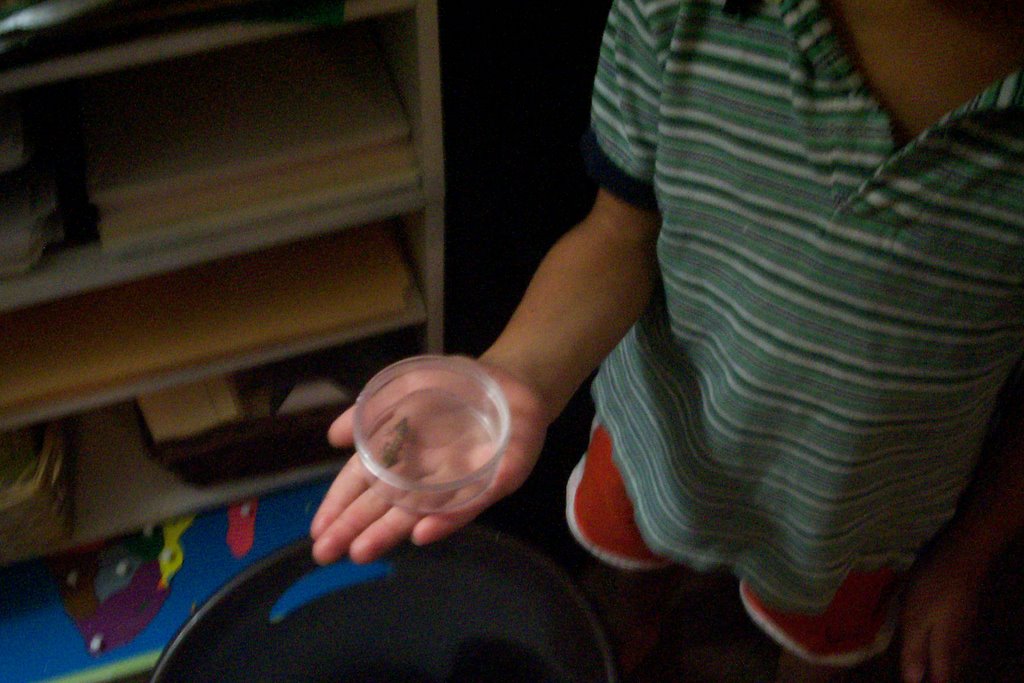
We spent part of the afternoon on Friday clearing out our courtyard so I could start getting things set up for our (3rd Annual!) haunted house, and when we picked up the sand and water table to move it to the backyard we found this little guy.

Scote immediately rushed in the house to grab his nature bag and field guide, and kept screeching to himself, "Oh, I just can't wait to research this!" and "What kind of lizard do you think it is? Do you think he is a carnivore?!! I hope he is in my book." and the like.

He is finally at that stage of independant reading (3rd-ish, I'd say) where the whole world of information (or at least most of our home children's library) is opening up to him. He still needs help on some of the larger and more esoteric words, but by and large he can find the information he needs by himself, and it was really gratifying to see how excited he was about doing his own research!

Days like this almost convince me to unschool full-time, but ultimately I think the kids thrive better with at least a few morning hours of challenge and structure, and I've seen such immense progress in our structured/sequential subjects (memory work, maths, Latin, history) that I can't imagine abadoning them...or at least not completely.

I guess what I am trying for, ultimately, is everything in balance.

A few focused morning hours of structured rigor in the schoolroom, and afternoons full of nonsense and play and nature where we can just follow the intellectual rabbit trail wherever it might lead. I imagine that is what made a good classical education in the past, that balance...it's a sort of Alice in Wonderland approach to education, I guess. Reading How Doth the Little Crocodile is so much more entertaining after having read How Doth the Little Busy Bee, otherwise you never even get the poet's joke at all! I think kids need the best of both worlds, to each enrich the other.

~EH

Tuesday, July 11, 2006

Thoughts

"Education is not the filling of a bucket,
but the lighting of a fire."
--W.B. Yeats
This is an interesting quote, and one that I have seen interpreted to fit (or belittle) just about any educational method. The unschoolers are fond of this, and interpret it to disparage "rote" learning, which is seen as a teacher pouring knowledge into a student.
This is an interesting interpretation to me, this contempt for formal education in the classical sense, one that on the surface seems completely true, but once you scratch the surface it reeks of nonsense. This point of view assumes that "rote" (ie "memorized, measurable knowledge of come fact or concept") is useless and that children can and will not be able to use or apply this knowledge. So they basically threw out the baby with the bucketwater.
How does one light a fire, albeit a metaphorical one?
Well, I don't know about you, but I would start with something fluffy and soft, something that will catch fire fast and burn hot, in other words, tinder. If all you did for 12 years was amass a huge random pile of this fluff, and lit it with a match your fire might look impressive for a short while, but then it would fizzle down to nothing, with not even enough smoldering embers left to light a new fire. This, to me, is what comes of a completely feel-good, wishy-washy, child-driven education. There is a time for gathering tinder (the early years, say before age 7 or 8), and a time to move on.
So what next?
Kindling, of course.
Our budding little fires are not ready for whole logs yet, so what do we do? We gather small twigs of just the right size, and dried enough to burn easily, although not as easily as the tinder. These have the benefit of burning longer and stronger than our tinder, but our fire is still not complete. In other words, we collect for them stories and ideas, facts and people, and help them absorb these into themselves.
If this fire is for an important purpose, we know we must take care and build a structure of solid hardwoods around it next. We use the best quality we have available, and we don't just throw it on top and smother the tender flames, but strategically place each chunk. At this stage we must watch ever so carefully to see that our fire has a solid start, protected from rain and the elements until it becomes strong enough to devour the wood on its own. This is a step almost completely lacking in modern education, a structure, a pattern, and a solid mass of knowledge.
At this point if the surrounding areas are dry and fire-friendly, our fire can now spread out in ways we never imagined, swallowing whole forests and fields that we might have never even seen ourselves.
So this brings me back to my original point, how can we presume to build a fire out of nothing?

Tuesday, June 20, 2006

Deep down within the waters dark, There lurks the dangerous Mr. Shark

One of the eccentric family's all-time favorite authors is Roald Dahl.

We actually stumbled into the Harry Potter series from reading an article comparing JK Rowling's style to his. How funny is that? Here the entire world was going gaga around us singing the praises of HP and I was completely disinterested.

What an idiot!

I swear sometimes I enjoy the HP novels more than the children. I stayed up all night to read the latest one, which was preordered in hardback edition and arrived in my mailbox promptly on the day of release! I have never done that with any other book. I still haven't read a single word of it aloud, I decided to save my breath and wait for the library to get the audio. Those books are just getting too darn long for read-alouds.
The kids are so jealous.

Anyway, back to Roald Dahl.

We've read nearly all of his novels. The lonely remaining two (I think), The BFG and The Witches, are already waiting on the shelf. We're only about four chapters into The Hobbit and I am already itching to start one.

The kids love The Hobbit, and they are learning a ton of new vocabulary, it's not that. It's just that our latest bit of memory work is Mr Dahl's poem, "The Shark", which has me all riled up for more.

If you love good-quality, funny, innocuous but sometimes bordering-on-rude children's poems (think: Shel Silverstein) then you should check out RD's Vile Verses. It's got hysterically funny poems from many of his best-loved novels including James and the Giant Peach, The Enormous Crocodile, and Charlie and the Chocolate Factory. I would also highly recommend reading those books. Matilda is another favorite. And don't be satisfied that you've seen a movie version or two, the best part about Roald Dahl's books is the humor contained in his writing style and rhymes, you lose much of that in a movie version. We always read the books first, and whenever I ask my kiddos which they liked better, they have always chosen the books.

In addition to poems from some of his novels, Vile Verses also contains amusing verse retellings of many classic children's stories which your kids are probably already familiar with. He puts his unique spin on Snow White, Goldilocks (that "brazen little crook" ..."Had I the chance I wouldn't fail, to clap young Goldilocks in jail"), The Tortoise and the Hare, etc.

So anyway, back to "The Shark". The language in "The Shark" is rich and not dumbed down, it has the complex sentence patterns you want in a memory poem, and it manages to reamain young-child-friendly and full of fun after many repeated readings/recitations.

Here is an excerpt from the ending stanza of "The Shark" to give you an idea of what a treat you are in for...

He lay there gnawing, nibbling, munching
Chewing, burping, grinning, crunching,
Until the whole of little Jim
Was pretty much inside of him.
He murmured as he ate the feet
"Small boys are awefully good to eat."

Check out Vile Verses, and spice up your poetry memorizations!


Monday, June 19, 2006

amo, amas, amat

It's amazing how much little kids can learn just from being around the bigger ones.

Today Dodo and I were conjugating amo according to the song we learned from LfC.

If you aren't learning Latin from LfC I'll tell you it goes like this,

amo, amas, amat
amamus, amatis, amant

amo, amas, amat
amamus, amantis, amant

amo-I love
amas-you love
amat-he is loving

amamus-we love
amatis-you all love
amant-they are loving

If you've ever heard the LfC dvd you'll immediately know the tune, it is very familiar but I can't seem to think of it just now.

Well, anyway, as I was saying, we were chanting today and little Ugha was chanting right along with us! It was so cute.

Here is Ugha's version...

amo, amas, amat
amamus, amatis, amant

amo-I love
amas-you love
amat-he a muffin

amamus-we love
amatis-you-gulls love
amant-they a muffin

~EH

Monday, June 05, 2006

The Latin-Centered Curriculum Quandry

The release of The Latin-Centered Curriculum from the (twangy, hillbilly-accented) people over at Memoria Press seems to reopened that old classical vs neo-classical can of worms, and most of us teetering-on-the-brink worms seem caught somewhere in the middle scratching our wormly heads with our tails in a semi-permanent, "Yes, but..." state.

Or at least I am.

Or am I?

I really can't seem to decide either way.


+Part of the problem is the sheer persuasive power of the classical-educationalists.

Studying rhetoric obviously has its advantages, I won't argue that, but it is also possible to manipulate and distort reality through rhetoric. Hitler was a very persuasive and charismatic leader, with many loyal followers, he must have said things that made sense to his people on some level. But there must have been some people scratching their heads and saying, "Yes, but..."

(No, I don't think the Memoria Press folks are evil dictators set on world domination. I quite liked their Prima Latina, and would recommend their products...I am just philosophizing on their ideas of what education should be.)

It is just like the purpose of the Socratic Method. You use carefully chosen questions to determine what the other person believes, then you use questions to break down his confidence in those beliefs and replace them with a "closer approximation" to reality.

But who's "closer approximation" of reality is it you are installing here? There is no such thing as an objective reality, so obviously you are attempting to make the other person think more like you, or more like Aristotle or whoever you happen to be studying at the time. This is not without its dangers.

I'm not arguing that it isn't beneficial for helping a developing child grow intellectually and gaining a grasp on the complexity of the adult perception of the world, but what happens when you do this to an adult?

Couldn't you conceivably supplant a perfectly reasonable and functional perception of reality with your own, different version not for growth, but for, say, the sale of your books and materials or the spread of your religious worldview?

Just a thought.


+Another thing that has me second-guessing the validity of their version of a "truly classical" education is the fact that while it is based on the education of the rich young boys of Athens and Rome, this form of education was developed predominantly in the medieval times, more specifically in the monasteries. I can think of some other things (the crusades, the Spanish Inquisition) which also developed of this era that I wholeheartedly disagree with.

They didn't call them the "dark ages" for nothing.

Now, this doesn't mean it is not a valid method, or not worth considering, but saying something is worthwhile simply because it is old and has survived so long is silly.


Now correct me if I am wrong, but the middle ages are not particularly well-known for their intellectual enlightenment. Are they really arguing that the people of the middle ages were more intelligent than modern men living in the information age?

To compare the relatively small populations of educated elites in classical Greece or the medieval monasteries to the billions of people in the modern West is hugely unfair.

If we were to segregate the sons of the rich and highly educated and send only them to public school from the age of 10 or 12 while all the "peasants" and girls stayed home I have no doubt they would be suitably advanced. You notice they never mention the learning levels of the 5-12 year old children of beggars, prostitutes, and peasants of the middle ages, yet man students in our public schools are just that. The teachers are forced to concentrate on those poor unfortunates and the other kids’ needs get neglected. (okay, the prevalent anti-intellectualism in our culture plays a part in that neglect as well, but I am getting off topic here).


And while a monastery education was quite the thing for a medieval monk, I am not so sure it is relevant for a 6 year old child in a well-educated, enriched, modern home in the year 2006.

I mean, think about it. I am sure that in those times, learning to illuminate a manuscript (and read and write them) was extremely beneficial for developing the aesthetic sense, small motor-control, visual discrimination etc. but should we then dedicate the next 12 years focusing on that? We could "bring in" other things as they pertain to the manuscript they are so diligently working on, like perhaps weaving a tapestry, spinning wool, or teaching them to hunt wild boar.

Just think of all the nature study they could learn hunting grouse or all the knowledge of anatomy they'd gain if we bought cadavers from the peasants to dissect in our dungeons, why they might even discover the miracle cure of leeching, or maybe laudanum! Maybe through our study of classical Rome they will discover what a tasty food additive lead is, and how beneficial as a building material for water pipes. After all, they never studied science except as it relates to classical times, so they wouldn’t know any better.

To act like there have been no development in thought worthy of study in the last 2000 years is insane.

And for PE they could run around in their 200 lbs of war armor or ride their war ponies, battle each other with little wooden swords!

Monasteries were like an oasis from the surrounding darkness, I get that.

They had libraries full of classical and biblical texts not because they were the best but because that's all there was. They learned Latin, not so they could develop their powers of thought, but so they could be "educated" ie so they could READ those texts.

It was (and is) through the actual reading of meaty texts and literature and the thinking about and using numbers and problem solving that the facilities of the mind were (are) honed. The content, far from being second to the acquisition of the tools, is the PURPOSE of learning those skills. The REASON for those skills.

Phonics is extremely beneficial, as is grammar, as is Latin...but they are just tools, means to an end.

And that end is reading and studying what the greatest minds of all time have to say about the world. We teach them math so they can solve problems and untangle puzzles, maybe discover some new truths of the world. We teach them logic so they can make sense of what they read and hear, know if a writer or speaker makes sense or doesn't. We teach them Latin so they will develop proficiency with languages (our own included) and have daily mental challenge to encourage mental growth. We teach them History so they will see the world and time from a broader perspective than the one at the ends of their noses, so they will be exposed to the most meaningful stories, so they can learn from the past and understand the present.

What possible sense is there to concentrating exclusively on classical history? You have the benefit of not seeing some of the evils that have sprung out of Christianity in the last 2000 years, I guess.

You also miss the whole sweep of growth and change that has taken place. Never in history have things changed so much in so little time, have so many advancements and improvements in daily life happened, and you want to ignore all that and focus on the Greek Gods?

Personally, I love Greek Mythology. I love Latin, and Philosophy. I want to share those things with my children. I think any educated person in modern times should be exposed to those things. I can also see the benefit of systematic, persistent Latin instruction to the mastery level.

But I can't see ignoring 2,000 years of history, mathematical and scientific advancement in favor of it.


Hmm. Guess I am not on the fence at all, am I?

Neo-classicists here, and darn proud of it!
Thursday, September 15, 2005

Grammar Time

I sat my Dodo down at the table, handed her a pencil, eraser, R&S 3 opened to her assignment, and a fresh sheet of paper.

"Grammar? Yuk." She says.

"Just do it."

"But Mom, this has no point!"

So I spend a good five minutes expounding on the benefits and necessity of a solid grounding in grammar, while she rolls her eyes.

She groans, sets her head on the table, and holds up her hand.

"The pencil, Mom," she says, shaking it in the air. "The Pencil has no point, see??!"

Oh yeah, I knew that.

-EH