Why do people complain about twos? "Terrible Twos!" is one parenting lament I have never been able to comprehend. 16-18 months to three years is my very favorite age. Kids are so bright and absorbant and so many parents ignore it and it stagnates.
I watched it happen with my SIL's kids, watched the little lights go dim, watched them develop into vacant eyed-zombies. I love those kids, don't mistake me, they are good kids and their mothers meant well (we all do) but they were lacking that "nature to nurture" gene, the one that looks at a toddler and just knows he is only crying because he is frustrated trying to master a confusing world and gives him the tools to master it. The gene that causes uncontrollable impulses to teach your child things instead of watching 7 hours of daytime TV, or at least during the commercials.
If you're reading this blog, you're gene is probably turned on already.
Homeschoolers keep up that nurturing when the other ladies pass the buck onto a series of poorly paid strangers, I know that. But I have some ideas some of you might like to use with your little ones, things I have done with all three of my kids, starting young, and all three little spongy intellects have responded well to them. And just because we have the urge doesn't mean we know what to do with it.
Reading the hundred or so books and articles on the subject as I have helps but nobody trying to homeschool has that kind of luxury. I still read voraciously but most of the bulk of that stuff I read back when I was pregnant with the Dodo, and I had long, luxurious days of laying on the couch and eating bonbons (when I wasn't throwing them up that is.) Anyway, you can benefit from my reading.
Ladies, Do not forget your little toddler while you're homeschooling your older one!! It's hard, I know, but try. Never again in their lives will their minds be quite so receptive, look at how quick they grasp language! Nurture their minds now, stretch them ever so gently and in a few years when you are trying to teach them decimals or Latin conjugations they will have developed the neurons to absorb it more efficiently and it will all be easier for you! GROW a "gifted" child. Whatever that means.
TEN BRAIN BOOSTING THINGS THAT SHOULD BE IN EVERY HOME WITH A TODDLER
~BLOCKS- old fashioned wooden blocks, LEGOs, tinkertoys, bristleblocks...
~BOOKS-Board Books with clear illustrations of everyday things as well as classic children's literature.
~SENSORY EXPERIENCES-Don't have a sandbox? Try a rubbermaid under the bed bin filled with dry rice and measuring cups. Mud too dirty? Make "Clean Mud" in a dishpan or plastic bin shred a few rolls of toilet paper and use a cheese grater to shread a bar of Ivory Soap, add warm water and Voila! Clean mud. It feels and smells heavenly. Let them help wash dishes. Fingerpaint with a few drops of food coloring and cool whip on a cookie sheet, make paper prints to keep. The idea here is to FEEL and experience something besides primary colored plastic things. Play and experience with REAL things in a controlled environment. Playdough, clay...you get the idea. No they won't eat it if you show them what else they can do with it. Its nontoxic anyhow.
~SOMETHING WITH THE ALPHABET ON IT-so when you sing (you do sing it don't you?) you point to the letter. Why do we do this as two separate steps? It's silly. My kids learned the letters and the song together, not as "schoolwork" but as baby play.
~SHAPES-If you can point to a turtle and say turtle and your baby gets it, why not the letter X or an octagon? An octagon is not any more difficult or abstract than learning the names of Sesame Street Charactors, we think it is because we learned it later, too much later. It will be harder then. Show them the shapes of things just like you say "cup" or "dog" both of those things are generically abstract catagories anyhow, think of just how many bizarrely divergent things we call by those labels and not many kids have trouble identifying a mug or a glass or a sippy as a cup or a rottweiler, chijuajua, or Clifford the Anthropomorhic Red Giant as dogs despite that. Why? Two reasons, First because the human brain is MADE to make connections and identify patterns, its what humans DO, and second, because we take the time to tell them those words, many times in many contexts. There is no sane reason to avoid these things until kids are older. I don't advocate force-feeding it, but you do it naturally. "What's this? A cup. What's that? An X. What's that? A trapezoid." Its all the same mumbo-jumbo when you are two, but they learn to decode it!
CRAYONS ETC You homescool so you've got that stuff, just be sure it is available for the little ones as well. A lot is learned from this scribbling.
MUSIC-you've heard of the Mozart affect, but what about the Barney effect? Whatever you choose music enhances brain development. Singing, chanting, rhyming are all brain boosters for helping them make sense of language.
SOMETHING TO SORT collections of buttons, seashells, attribute blocks. Model how to do it and let them play, they will catch on faster than you think. Don't wait until Kinder! Have this stuff around for the little ones where they can see it, once in awhile take it out and play with it yourself and they will want to try it, guaranteed. My kids love this sort of activity at 2. A Jar of buttons, a tray and some ice cube trays and you are on your way to advanced math concepts.
MANIPULATIVES-try different bottles with caps, strings and something to lace (cheerios, beads, noodles) for very small ones let them lace bigger things on one of those big pipe cleaners. You can get macreme beads from an art store for WAY cheaper than educational stores sell wooden beads and they are the same thing, but with less glaring colors. Don't you get tired just looking at a room full of competing primary and pastel colors? So do your kids. Yes, they like color. Yes, they respond to it. No way should every last thing be those colors. Overkill, no? (Think ADD, have you SEEN some of those public school classrooms kids are supposed to learn in? It's overstimulation-city!) Twos should spend at least some of their time everyday "doing things" maybe just small chiunks of time at first, but real tasks. You can see when they are learning, their breathing changes, they get very focused. You want to encourage this, promote it, stretch it a few seconds longer when they start to lose interest. You are building neurons.
TIME WITH AN ADULT- a lot of time. A lot of talking. A lot of playing, not just with siblings but with you, the richest brain-boosting resource of all, YOU! Think about a lot of the educational toys on the market today. Most of them try to mimic a knowledgeable adult, endlessly patient, chirping "CAT" or "DOG" or "AUSTRALIA" with every push of a button. The toy developers know this. The best thing you can do to boost your child's brainpower is to spend time interacting with her. Really interacting.
Boy I'm overly didantic tonight, sorry for that.
-EH


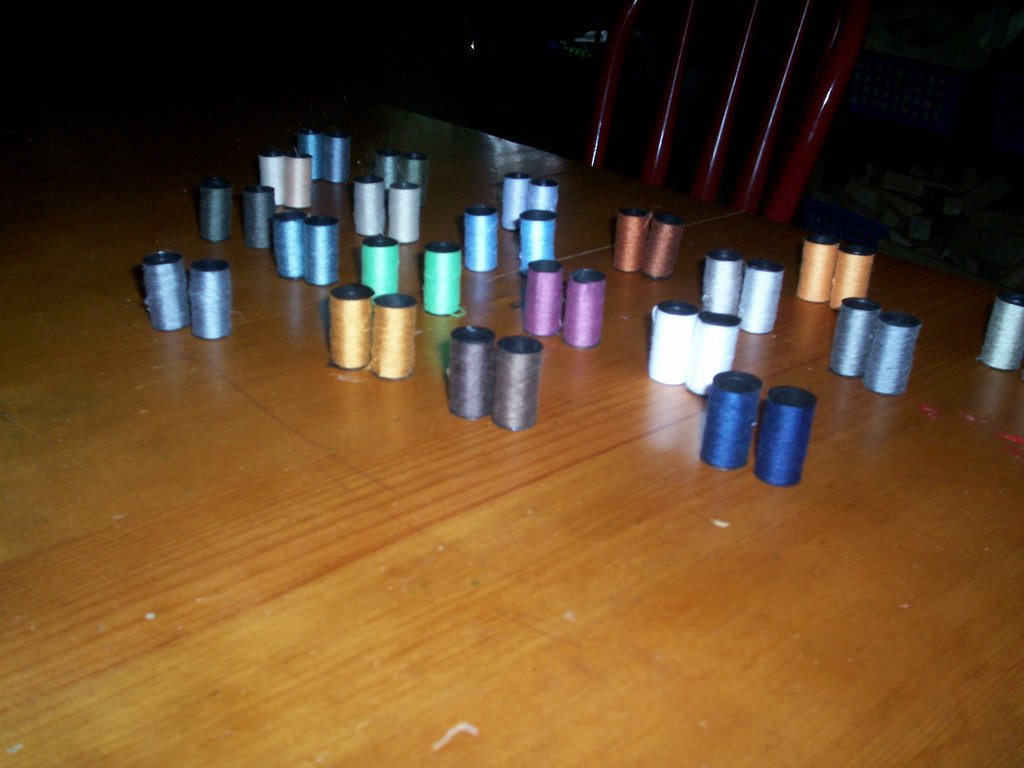
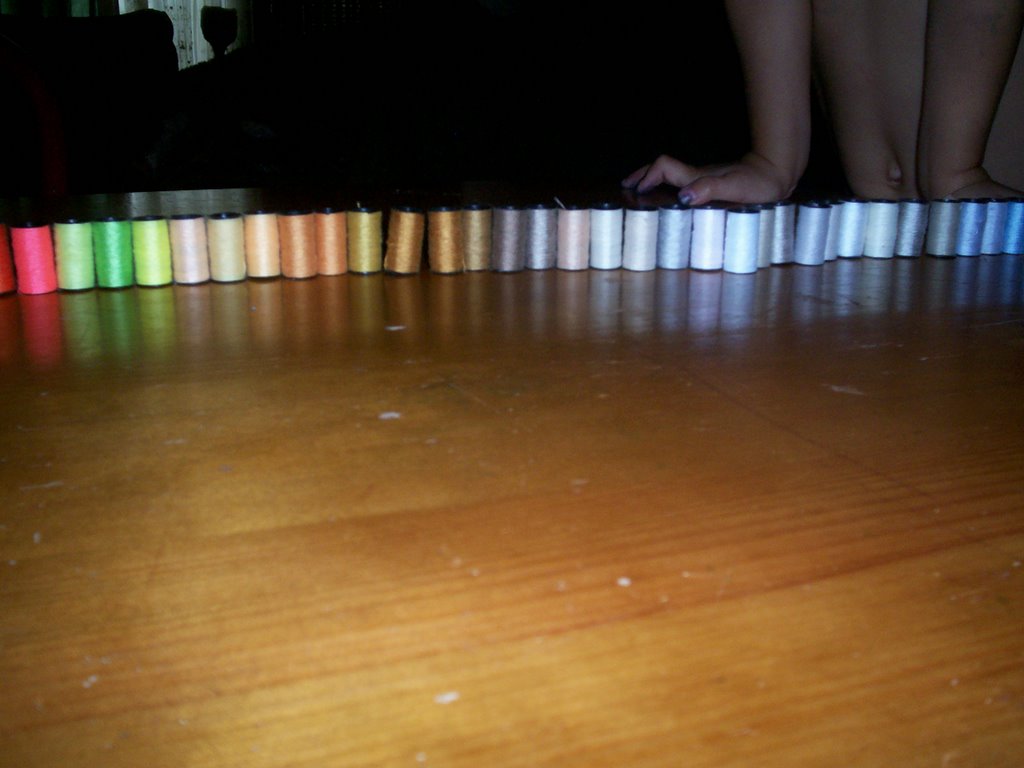
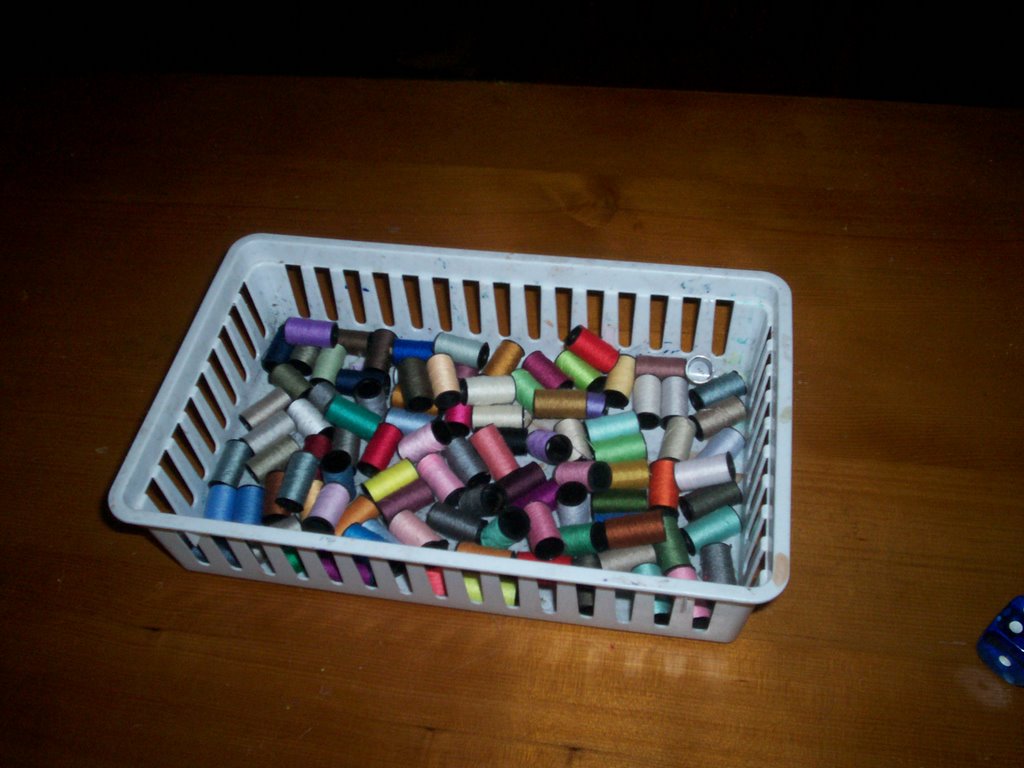 I was at the dollar tree the other day and bought two 50-packs of colored thread, thinking they would be great for matching and sorting.